
From seven students in 1876 to a thriving community today
On 22 July 1876, residential life at St Andrew’s College quietly began.
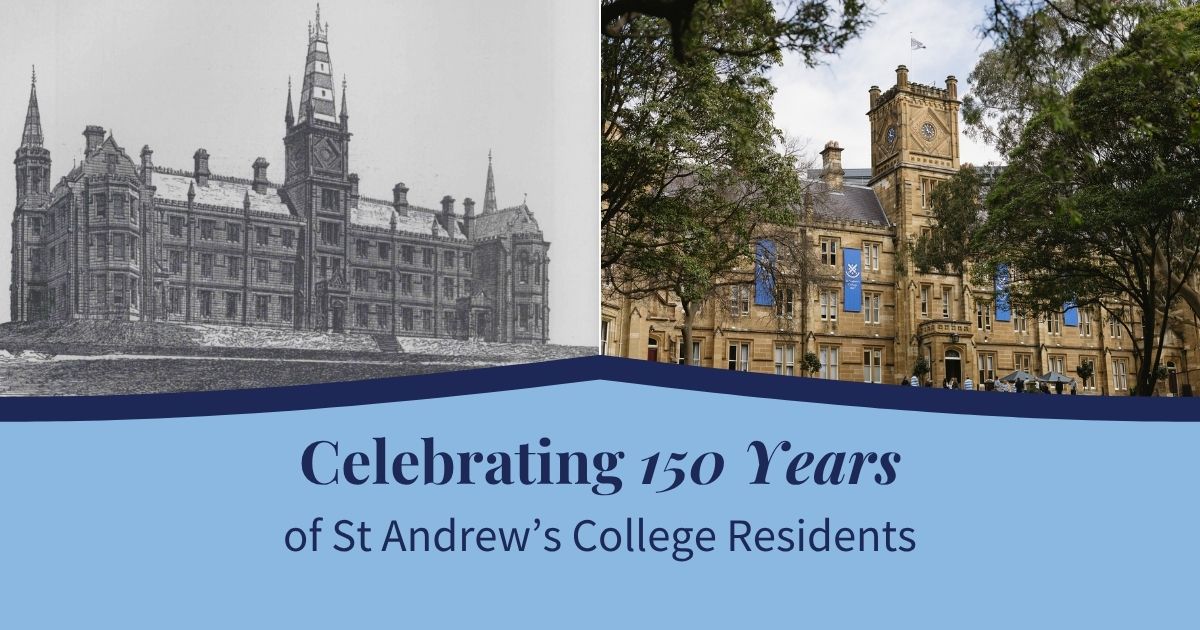
Rev James Cameron, the Moderator of the Presbyterian Church, officially opened the Main Building, designed by William Munro. Although its presence was imposing, it was not yet complete. Only the ground floor was habitable, with students accommodated between the entrance and the Principal’s lodging, while the upper levels remained unfinished.
In that partially completed building, with floorboards still being laid and construction ongoing above them, seven residential students began a new chapter in the College’s history.
It was a modest beginning. But it was also a defining one.
The first seven students
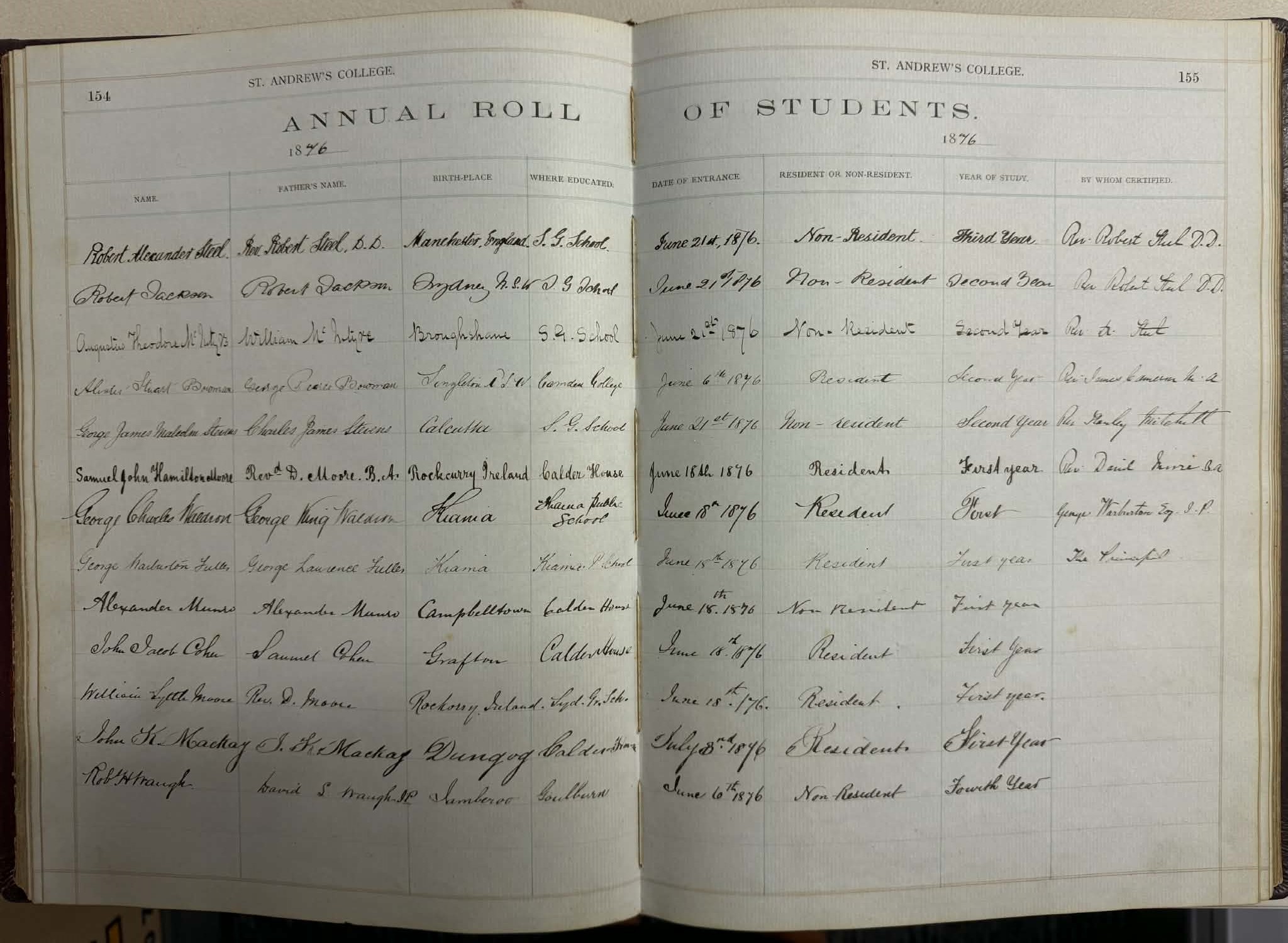
The first residential cohort, recorded in the Annual Roll of Students, numbered just seven. Yet each would go on to contribute meaningfully to public life in Australia.
They included John Jacob Cohen, who became an architect, politician, and judge; George Charles Waldron, William Lyttle Moore, and Samuel John Hamilton Moore, all solicitors; Alister Stuart Bowman, a doctor and grazier; George Warburton Fuller, a barrister and politician; and John Kenneth Mackay, a grazier.
Their paths would extend far beyond the College walls, but their formative years at St Andrew’s marked the beginning of a shared connection to a residential community that would continue to shape their lives.
(Image: Page from College Roll of Students 1876 (SAC Archives Ref A2_1) (1))
Lives shaped by service and leadership
Across their diverse careers, these early Androvians carried a common thread: service.
Alister Bowman served the Singleton community as a medical practitioner for fifty years and was also involved in the NSW Lancers. George Warburton Fuller went on to serve in both State and Federal Parliament and remained closely connected to the College, serving on Council for nearly half a century and becoming its longest-serving Councillor.
William Moore and George Waldron pursued distinguished legal careers, both remembered in contemporary accounts for their professionalism and standing within the legal community. John Mackay transitioned from medicine to pastoral life, becoming known for his generosity and quiet philanthropy.
Behind these careers lies a shared foundation: the early experience of residential life at St Andrew’s College.
A College shaped by inclusion and connection
Even in its earliest years, St Andrew’s reflected a breadth of backgrounds and experiences that continues to define the College today.
John Jacob Cohen, one of the first residential students, was also the first Jewish student accepted into any affiliated college at the University of Sydney. Initially hesitant about applying to a Presbyterian institution, his concerns were eased by the welcome he received, something he later described as central to the College’s enduring spirit.
His legacy continued across generations, with both his son Cedric (Fr 1909) and grandson Brian (Fr 1945) becoming Androvians, reflecting a deep and ongoing family connection to the College.
Similarly, the Bowman family name remains embedded in the College’s physical and cultural fabric, remembered through scholarships and the stained-glass windows that continue to frame the Main Building entrance.
Continuity across 150 years
While the world beyond St Andrew’s has transformed dramatically since 1876, the essence of residential life remains remarkably consistent.
Then, students lived on a single completed floor of an unfinished building. Today, they live across a vibrant residential community within a fully developed College.
Then, seven students formed the first residential cohort. Today, generations of students call St Andrew’s home each year.
Then, the College was beginning to define itself. Today, it continues to be shaped by the thousands of students who have lived, learned, and contributed to its story.
The story of St Andrew’s College is not only one of buildings and milestones, but it is also a story of people.
It is a story of seven students who began something larger than themselves. Of families whose connections span generations. Of individuals who went on to serve their professions, their communities, and the broader public good.
It is also a story of continuity, of values carried forward across 150 years of residential life: belonging, service, leadership, and connection.
As we mark this milestone in 2026, we celebrate not only where we have come from, but what continues to define us today.