

Growing up on a small farm outside Murwillumbah in the Northern Rivers, St Andrew’s College alumnus Jonathan Lobban has followed a path shaped by curiosity, culture, and a deep appreciation for people and place. After two years at Drew’s filled with sport, camaraderie and the vibrant individuality of College life, Jonathan’s journey headed in a new direction – which included playing rugby in Dublin to discovering a passion for literature that would launch his career in publishing and editorial work.
Since joining M.J. Bale in 2009, and now as the brand’s long-standing Head of Brand, he has helped steer the company through more than a decade of growth – championing provenance, sustainability, and partnerships that honour the people behind the product. Reflecting on his upbringing, his time at Drew’s and the global experiences that shaped his creative career, Jonathan brings a thoughtful, grounded perspective to leadership and brand building. Today, his work continues to bridge culture, craft and purpose, driven by a commitment to authenticity, integrity and the communities that make great stories – and great style – possible.
Can you share a bit about your background – where you’re from and where you grew up?
I grew up on a little farm outside a town called Murwillumbah in the northern rivers of NSW. Dad was the local vet. Murwillumbah was a beautiful place to grow up. My school was surrounded by sugar cane fields, and all the kids were children of farmers, professionals, tradies and hippies. Everyone got along. Life was simple. Rugby league in winter, cricket in summer. We swam and fished in the creeks all year round. I love what Hemingway wrote about Paris in his memoir, A Moveable Feast, when he said, “There were no problems except where to be happiest.” That’s exactly how I remember growing up in Murwillumbah: no problems, just happiness.
What led you to choose St Andrew’s College back in 1996? What was it about coming to College that appealed to you?
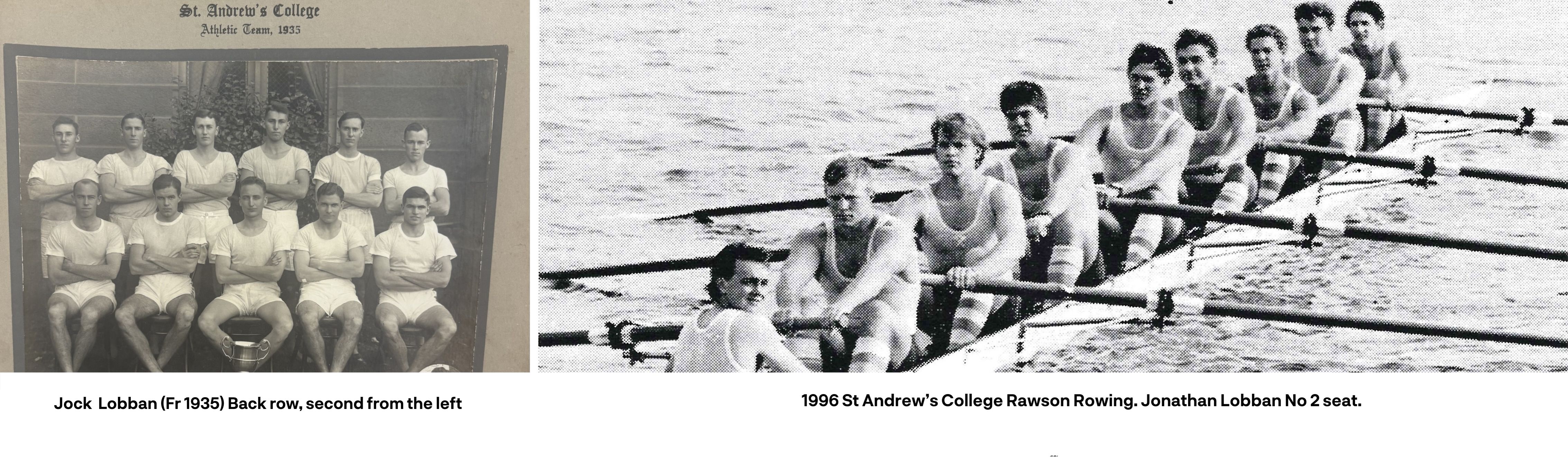
My grandfather, Jock Lobban, was a fresher at Drew’s in 1935. He came up from Melbourne Uni as a senior. He was a good athlete and made an Australian long jump record while he was at Drew’s and played rugby for Wests. He also met my grandmother, Nina Vickery, at Sydney Uni when they played doubles tennis together. Jock died during World War Two when my father “Dick” Lobban, was three, which was a huge loss. I think dad grew up looking at the team photos of Jock in his Drew’s kit and the place felt like home to him. Dad went to Drew’s as a mature age fresher in 1962. He loved his time there so much he married my mother in the college chapel. I was probably too immature and rebellious to get the most of out of college, but my daughter, Frankie, was a fresher at Drew’s in 2023. Seeing how the experience helped mould her, the friends she made, was lovely to see.
What did you most enjoy during your time at College? Was it culture, sport, friends, social life? How did this impact your experience here at Drew’s?
Sport, for sure. I rowed and played basketball for the college my first year and played rugby both the years I was there. We won the rowing and then the Rawson Cup rugby in my second year. The intensity of the rugby is a memory I will never forget. We took a lot of pride in performance and enjoyed playing together.
Reflecting on your time at St Andrew’s, how did it influence your personal and professional journey after College?
In one way, Drew’s reinforced the importance of sacrificing your individual agenda for the benefit of the team. Equally, though, Drew’s taught me the importance of self-expression and being an individual. The college during my time was a collective of real eccentrics and being yourself – as long as you were reliable and put in for the team – was a good thing. These things I found were beneficial for life after Uni.
What sparked your interest in a career in publishing, editorial work and branding? What aspects of these industries did you find most compelling?
I didn’t ever have any ability for writing or interest in publishing. But I was playing for Randwick and left Drew’s three-quarters through my second year to play rugby for a club in Dublin. I was lucky enough to live with a family in Dublin who were very passionate about their history and culture, and I spent a lot of time in the Trinity College library reading Irish literature. The Irish writers made me fall in love with the written word, and everything behind it.
Early in your career, you worked across multiple magazines as Editor and was Founding Editor in Chief of The Rake magazine. What were these roles like and how did these early experiences prepare you for your current role?
I loved magazines because you had the opportunity to travel often and interview interesting people and draw out their stories. When you meet unique people who have a deep conviction about why they do what they do, it inspires you, and you learn a lot. Working in magazines also gave me the opportunity to live and work in places like Italy, Hong Kong and Singapore, and it was a rich experience.
You have worked with M.J Bale since 2009 – what has it been like to be with the company over the past 16 years?
It has been hard work, but it’s been fun. We’re 16 years old this year, but it feels like we’re only just getting started. I remember in October 2009, about a month after we launched M.J. Bale, our founder, Matt Jensen, and I went to a meeting in Sydney with a clever guy. He told us to create ‘brand pillars’ – values, principles – to guide every decision we made moving forward. We chose ‘Provenance, Authenticity, Integrity and Character’ as our pillars, and we have tried to stay true to that path as much as we can ever since.
What have been your biggest achievements so far in the role? Is there anything in the works you can give us a sneak peek into?
Personal achievements, I couldn’t tell you. As mentioned, it feels like we’re still just at the beginning of the journey. If things line up, we would love to launch M.J. Bale internationally in 2026 and have a crack at the northern hemisphere.
What’s it like to work in the fashion industry? What are the highlights? Are there any challenges?
I’m not really into ‘fashion’. What I love about the industry is the supply chain – the families and communities behind the clothes, like woolgrowers, weavers, tailors, artisans etc. To make a beautiful product it has to be created with beauty, and by ‘beauty’, I mean dignity and integrity. The challenges are trying to stay relevant in a mercurial market with a product considered timeless and classic.
Is there a typical day in your position? If so, what does it entail?
No, no two days are ever the same. My role is to basically develop our brand strategy, identify and work with the partners that can bring the strategy to life, and then tell our stories. I am lucky that I get to spend a fair bit of time with our woolgrowers in Tasmania and New Zealand, our tailors and weavers in Japan and Italy, and internally our sustainability, marketing and creative teams. They’re all good people and it mostly doesn’t feel like ‘work’ at all.
M.J. Bale is renowned for its commitment to sustainability and craftsmanship. Could you elaborate on how the brand positions itself within the Australian fashion market? How does the brand differentiate itself and position its image within the broader fashion industry?
We’re all about natural fibres – Merino wool, in particular – and the communities that produce it. About 96% of everything we produce is from natural fibres, be it wool, cotton, linen or silk, and we’re making ground on the remaining 4%. We’ve done a single-source tailoring collection with Kingston farm in Tasmania, a conservationist woolgrowing enterprise, for almost ten years now and will launch a similar collection with a New Zealand woolgrowing family next year. We give back to these farms a percentage of every single-source garment sold in our stores, and the farmers have to reinvest that rebate into biodiversity preservation and revegetation projects. It’s a nice circle, and from what I know is unique in Australia, if not the world.
In 2023, M.J. Bale partnered with Sea Forest Australia to collaborate on finding a way to produce Methane-Reduced wool. Can you share a bit about the partnership, your role in developing this and how M.J. Bale’s future looks with such a successful initiative?
It was serendipitous, really. In 2019 we did a carbon footprint assessment of our business operations and entire product range. 52% of emissions related to our legacy garment, the wool suit, came from sheep methane emissions. I happened to run into an old mate of mine, Sam Elsom, who at the time was growing a native seaweed called asparagopsis taxiformis off the coast in Tasmania with his company, Sea Forest. The CSIRO had published a paper back in 2016 proving that asparagopsis mitigated methane production by more than 80% when a small amount is fed to ruminant livestock daily, and Sam had run with it. I called Kingston woolgrower, Simon, and asked whether he was keen to trial the seaweed feeds with us. We got the University of Tasmania on board to monitor the trial, and then, later, the CSIRO. We made some beautiful knits here in Victoria from that initial 48 sheep, then over the subsequent years we’ve had enough wool to make a blazer in Italy. In terms of our future, we will continue to work with the science, agriculture and tertiary industries on better ways to create products that, we hope, are climate positive.
When M.J. Bale became B Corp certified in 2024, it marked a huge step in sustainability and accountability. From your point of view, how has that milestone changed things for the brand? How have you personally helped bring it to life, and why do you think going through this process matters for fashion labels today?
The B Corp certification keeps us honest. We’re far from perfect, but we do try to make sure no we have continuous improvement in all aspects of business. With regards to the fashion industry, I think in the very near future companies will be held even more accountable for the impact of the products they bring to market, whether that’s synthetic fibres or stakeholder welfare.
What advice would you offer to current students interested in pursuing a career in editing or branding, or in the fashion industry?
Whatever you do, try and bring a fresh perspective and diversity of thought. Try to connect what exists, or what you believe needs to exist, with new ideas, research and information. Look for unorthodox partnerships. Unlikely alliances create unexpected positive outcomes.
Outside of your professional commitments, what activities help you unwind and maintain a healthy work-life balance?
I’m not sure if the work-life balance really exists, but I love spending time with my family, the beach, touch footy with mates, reading, cooking… taking things as slow as I can.
Looking ahead, what are your goals for the upcoming year? Are there any new projects or aspirations you’re excited about?
Does equanimity count as a goal? If so, that would be it.