
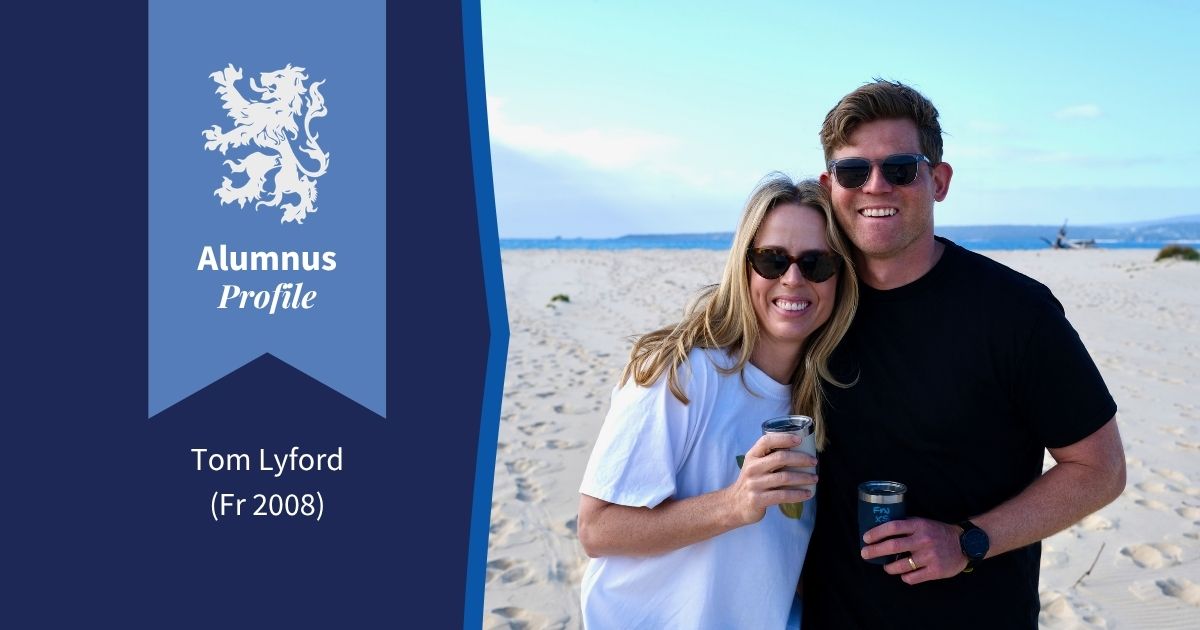
The friendships you make at residential college tend to be the ones that last. Hailing from a small town in the Hunter region of NSW, Tom Lyford was surprised to find that St Andrew’s College offered far more than just accommodation when he arrived on campus. However, not unlike many alumni, Tom walked out the door on his last day at College with a budding relationship with his wife, Penny Lyford (Fr 2007), and an abundance of lifelong friends. Now working as a doctor in Newcastle with a growing family, and despite the challenges of distance and time, Tom still counts the connections he made at College as strong as ever.
You grew up in Gloucester — for people who don’t know it, how would you describe the place and what it was like to grow up there?
Gloucester was and is a very small farming town of about 3500 people. Everyone knew everyone and it was a fairly free-range childhood with the Barrington River as our playground. It was a typical small town with one high school and five pubs, but there was ample space to explore. I had some great formative experiences like working at the hardware shop and the outdoor adventure centre, whilst getting involved in any sport available in the town.
What was the path to St Andrew’s for a kid from a state school in regional NSW? Was it your idea, or did someone push you toward it?
I didn’t know St Andrew’s existed at the time. I applied after speaking with a friend who went to school in Sydney, and I assumed it was simply a residential building where I could eat and sleep; I was pleasantly surprised when it was much more than that.
Do you remember arriving at Drew’s for the first time? What was that like — walking into this sandstone college from a town of a couple of thousand people?
I will never forget arriving for my interview, the impact of the sandstone building itself was remarkable, particularly after attending a school constructed mostly of demountable classrooms. I arrived while the current students were forming a victory tunnel at the front door of Main to celebrate one of the sporting teams. I had to unceremoniously shuffle up the middle of the tunnel and into the main building to meet with Dr Porges, I’m sure to the great amusement of the students forming the tunnel – but it sparked a curiosity as to what this place was all about.
Who are the Drew’s people still in your life, and what do those friendships mean to you now?
My college friendships are all incredibly close, and have endured through relocations overseas, demanding careers and having families. As Penny is also a Drew’s alumni, our friendships span across a few year groups which is quite special, so it is a fairly long list of people still in our lives; some we wish we could see more. There is a huge amount of respect, loyalty and support that is shared, even when it is too long between catch ups. They have all done extraordinary things, and it’s been great to watch that evolve from our university days.
You met Penny at College — we’d love to hear that story. How did it happen, and what role did Drew’s play?
The narrative has probably changed a bit as time has passed, but naturally, meeting Penny is a standout memory. Penny started the year before me, so it wasn’t a straight road to capturing her attention as a fresher. It was over a year into college, as we had first become friends over that time. A few extended hours in the dining hall or in the glen chatting, some Highlander parties, and some lingering at ‘buffet’ for a chance encounter shifted us into something more serious. It has been about 18 years, two kids and a dog later; we have quite a few friends with a similar story, so we credit the Drew’s environment for providing that unique opportunity for meaningful quality time and space.
What’s a memory from your college years that still makes you smile — the kind of story you still tell?
The first things that come to mind are not the VD’s or big celebrations and wins. I find myself reflecting on memories that cemented friendships and brought us together- I recall a particular failed schnitzel eating competition for example which continues to be brought up amongst my group of friends to this day.
Looking back, what did Drew’s give you that you didn’t expect when you arrived?
I was a small-town kid, and Drew’s really shifted my perspective in many ways. I was inspired by those around me, everyone was doing something different or had different skills and interests, which just broadened the way I envisioned my own future. This definitely inspired me to pursue a career in medicine. I also couldn’t have imagined meeting a better group of lifelong friends.
You spent around six years in Wagga — as a junior doctor, in the ED and as a registrar. Was that a deliberate choice to go regional?
Growing up as the son of a doctor in a small community likely influenced the decision to move to a regional town, and it felt like a natural fit for that time in our lives. I was looking for a balance of an interesting, varied career, and a lifestyle that was a slower pace. The great thing about rural medicine is the sense of community amongst both the medical fraternity as well as with your patients. There is a closeness amongst rural medical colleagues that is committed, supportive and hard to replicate. I am still running into people with a shared connection to the medical community in Wagga.
Emergency medicine alongside general practice training is a fairly intense combination. What was that period like?
I had planned to undertake a rural proceduralist program in emergency medicine and general practice; however, COVID hit at a time when I was balancing the two, which became challenging. The intensity of those few years firmed up my desire to move solely into general practice.
Is Newcastle home now? What does life look like for you and Penny beyond the clinic?
Newcastle is most definitely home. It has a great regional community feel, with touches of city life, and only seems to be getting better the longer we are here. Pen and I are surrounded by great friends and live close to the beach. We bike ride, explore the local Glenrock national park and surrounding beaches and get back to Gloucester when we can. We are in the thick of raising a 6 and 4-year-old and are busy supporting their long list of activities and interests.
What would you say to a current St Andrew’s resident — especially one who’s come from a country town or a non-traditional background — about what’s possible?
I would say that someone who has arrived at Drew’s from the country and has made it this far, will already be embracing the opportunity that Drew’s offers. It can, however, be more daunting or intimidating for rural students, especially if like me, you just haven’t been exposed to the type of education, facilities and experiences that some of the other students have had. It’s important to see that as a strength though and be open to the idea that you really can do something you never thought you would.
What does St Andrew’s still mean to you, all these years on?
I’m incredibly grateful for the years I had at Drew’s, mostly for the lifelong friendships (and marriage), and for those who continue to come out of the woodwork, including our awesome group of Drew’s alumni in Newcastle and the Hunter region.